Indica vs. Sativa: the differences
It can feel as if there are endless cannabis strains.
Most of them belong to the Sativa and Indica families.
But what does that actually mean?
Both cannabis types have different properties and different typical profiles.
We will introduce you to both types.
That way, you can get a better sense of which cannabis strains may fit your use best.
What is Cannabis Sativa?
Cannabis Sativa, true or common hemp, is one of the oldest cultivated plants in the world.
Industrial hemp has been used for more than 8,000 years as a textile and building material, as food, and in medicinal contexts.
The medical use of substances contained in Cannabis Sativa oil is especially interesting.
These primarily include THC (tetrahydrocannabinol) and especially CBD (cannabidiol).
Although Cannabis Sativa contains at least 113 cannabinoids alongside roughly 500 different active compounds, the medical profile of Sativa hemp is shaped especially by THC and CBD.
What is Cannabis Indica?
Indian hemp, usually known as Cannabis Indica, is commonly understood as a cannabis type with relatively high THC and CBD content.
It is primarily grown to produce hashish and marijuana.
Botanically speaking, however, there are also some types within the Indica group that are not used only for drug or hashish production.
They are also cultivated for fiber and oil production.
In our description, we focus on Cannabis Indica types bred for the use of CBD and THC compounds.
Like in Cannabis Sativa, these compounds are medically relevant.
Differences in Sativa and Indica profiles
It is interesting that both Cannabis Sativa and Cannabis Indica contain THC and CBD.
However, they are often experienced in different ways.
Experiences after smoking or otherwise consuming cannabis vary widely.
Still, two broad impressions usually shape the experience after consumption.
You may feel energized and light, or calm and relaxed.
People often describe this as high or stoned.
The Cannabis Indica profile
Because the CBD-to-THC ratio in Indian hemp is higher, the profile is often described as heavier and more body-focused.
Users often describe a quieter, more grounded tone.
In medical contexts, people also discuss antispasmodic, anxiety-related, and inflammatory indications.
Drowsiness and lightheadedness can occur.
Forgetfulness may appear as an unwanted side note.
Especially with regular high consumption, drowsiness, forgetfulness, and passivity can become a problem.
Science has not yet conclusively clarified whether these profiles are due to the higher CBD content.
Other compounds and their combinations may also be responsible.
Scientific research into cannabis and marijuana is still relatively young.
Only with increasing legalization has research expanded and received more support.
The Cannabis Sativa profile
Even though scientific proof is still limited, users of Cannabis Sativa more often report creative, lively sessions.
A bright mood and spontaneous amusement, sometimes showing up as giggle fits, are also reported more often.
Cannabis Sativa has a high THC content and a lower CBD content.
That is why people associate it with a so-called cerebral character: more active, lighter, and often linked with inspiration and creativity.
Other reported associations include:
- Focus and alertness
- Nausea-related medical contexts
- Appetite-related medical contexts
- A brighter overall tone
However, newer scientific studies are putting forward even more interesting theories.
Researchers are discussing whether the different profiles of cannabis strains may not come so much from CBD and THC levels, but rather from terpenes.
Examples include myrcene in Cannabis Indica and limonene in Cannabis Sativa.
How can you tell Cannabis Indica and Sativa plants apart?
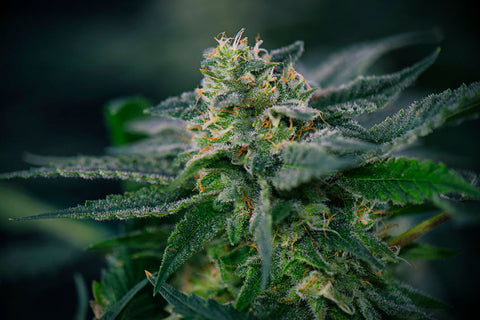
Cannabis Indica tends to look compact and bushy, with lush, heavy, strongly scented flowers.
The buds grow in clusters around the stem nodes.
The spacing between the nodes is relatively short, which creates the compact, bushy growth.
The fan leaves are also broader and shorter.
When Cannabis Sativa plants grow under the same conditions, they become taller and slimmer, with fewer branches than Indica strains.
The flowers tend to grow less compactly, forming looser clusters along the shoots.
That makes them appear longer, but because of their lower density, they have less mass when dried.
The leaves are narrower and longer.
The smell of the buds, whether fresh on the plant or dried, is also not quite as intense as with Cannabis Indica.
The flowering times of Indica / Sativa
A major difference between Cannabis Indica and Cannabis Sativa is their flowering time.
Indica strains spend 45 to 60 days in flower.
Sativa strains have a longer flowering period of about 60 to 90 days, which also gives them a somewhat longer cultivation cycle.
The shorter flowering time of Cannabis Indica requires more nutrients.
Because of its dense bud structure, susceptibility to mold should be considered.
Sativa strains, on the other hand, need plenty of light and higher temperatures to grow.
Indica vs. Sativa: which is better?
There is no single clear answer here.
What matters most is which type of experience you prefer.
If you would rather spend a quiet evening relaxing and letting the day fade out, Cannabis Indica may be more suitable for you.
If you would rather do something, feel creative, or stay upbeat, Cannabis Sativa may be a better fit.
If medical reasons play a role in your choice, such as:
- Anxiety
- Tension
- Pain
- Depressive moods
Then you can learn more about the use of medical hemp and ideally make a decision in consultation with your doctor.
Informing yourself about the different profiles beforehand is a good starting point.
What speaks for using medical cannabis?
THC and CBD play a role when it comes to the use of medical hemp.
Cannabis on prescription has been available since March 1, 2017.
Cannabis-based medicines and medical cannabis flowers may be prescribed on a narcotics prescription.
The maximum prescription quantity is 100,000 mg, or 100 g, in 30 days.
Prescribing cannabis strains with different THC levels is also provided for.
That means cannabis flowers can be prescribed for different indications.
Several factors are especially useful here:
- First, the legal situation is clear and consumption is fully legal.
- Second, all of this happens under medical supervision, so unwanted side effects or dependencies can be monitored and addressed.
- In addition, the active ingredient quantities are clear and officially controlled, so nothing is left to chance.
What must be present, of course, is a medical indication and your doctor’s willingness to prescribe a product for you.
So if you only want to enjoy a joint from time to time for fun, medical cannabis is unlikely to be an option for you.
CBD and terpenes as possible alternatives
You can learn more about CBD and terpenes, the aromatic oils of the cannabis plant, on our blog.
We offer products built around these aromatic plant compounds and their distinctive profiles.
Here you will also find tobacco alternatives for joints if you want to skip nicotine completely.